Regarding Their Intent to Close and Demolish The National Glass Centre, Sunderland
14th March 2024
Dear Board of Governors
How do histories end? Is it through neglect, by the misguided actions of a few, the averted gaze of many, or by compliance when there should have been challenge? This year 2024, is thought to be the 1350th anniversary of the start of glassmaking in Sunderland. An important historic event many want to recognise and celebrate.
Instead, in 2026 it will be the end of that history if the University of Sunderland is successful in its campaign to demolish our National Glass Centre (NGC) and in the process deny future generations the opportunity to understand, revere and continue the history and tradition of glassmaking in our unique and proud city. Given that this will cause extensive, irreparable economic and cultural damage it is natural that this decision should be open to the highest levels of scrutiny.
When the University, as owners of the NGC, made the shock announcement in January 2023 of its intention to close and demolish Sunderland’s “world class cultural asset” (2021 City of Culture Bid), it was met with widespread disbelief. People immediately questioned how the University could announce that it would cost £45million to repair an existing building when the construction costs for the brand- new Culture House in the city centre are reported to be £25million. It is not even clear what the basis is for the £45million cost as it was not an option covered in GSS Architecture’s 2022 Roof Level Feasibility Report. There was no explanation as to why the more affordable Option 2 costing was not considered.
The £45million figure has been met with derision by construction industry professionals who have examined the Cost Estimate in detail (see attached Report pg 9 onwards), and who point to Option 2 as a viable solution. Has the quoted repair bill of £45million discouraged any potential financial backers?
The University’s actions show scant regard for, or reference to, the usual regulatory framework, including the: Town and Country Planning Act 1990, Charities Act 2022, Health and Safety at Work Act (HSWA) 1974, Management of Health and Safety at Work Regulations 1999 and The Seven Principles of Public Life (Nolan Principles) 1995.
According to The Seven Principles of Public Life, as a Board of Governors you are “…public officeholders… both servants of the public and stewards of public resources.”
Yet the decision to close and demolish the NGC was made without any public consultation over what would happen to a much treasured educational establishment, visitor attraction and charity, run solely for the “public benefit”.
Instead, your Executive presented you with a set of biased, partial evidence. The decision was made without an Impact Assessment, or a Change Programme, or planning as to the future usage of a site with limited potential for redevelopment. There has been no strategic plan to ensure sustainable, future growth. In addition, there has been no viable plan to relocate the many and varied functions of the building, the academic courses, the galleries, the public engagement and visitor facilities and tenanted studios. This is an astonishing lack of objectivity, due diligence and a rejection of well-established management techniques used to arrive at Best Outcomes. The only determination was to rid yourself of the civic obligations of ownership of a public, charity run asset, described by Vice Chancellor, Sir David Bell as “the burden” when he wrote that “…the University cannot be expected to carry all of the burden on that front…” (letter to Bridget Phillipson MP, 24.08.2023). He considers that “…much of what takes place in the Centre is not ‘core’ to the University’s overarching academic mission as an educational institution…” (letter to Julie Elliott MP, 14.05.2023). His approach to the ethical function of a university within society is somewhat different to other universities such as Durham University, which evidently applies a different moral stance when running its seven visitor attractions.
In October 2022 the Executive’s evidence, the Roof Level Feasibility Report (2022), led to the University making major structural changes to the NGC’s main glass façade by removing the brise soleil and external frame. This was done without planning permission or the involvement of Building Control.
Contractors removed the bracing that stiffened and strengthened the façade and protected it from the force of the wind. Damage occurred in October 2023 during high winds, but before the main impact of storm Babet. Luckily no one was hurt when a large panel of glass dropped out of position. It is the very definition of a near miss; for a year thousands of people worked, walked, sat, ran and cycled past tonnes of glass held in a potentially weakened structure due to the University’s maintenance choices. It led to the University declaring the façade as a “dangerous structure”. Whilst Sir David Bell has continued to insist that it was: “…simply untrue to suggest that the University has failed to maintain the building adequately.” (letter to the office of Julie Elliot MP, 26.10.2023). The University Environmental Sustainability Plan 2025 states that it has been neglectful of the fabric of the building in that they “…fail to plan, invest and maintain the University’s physical estate…”. In addition, it has revealed that “The University does not have an Operation and Maintenance document for the NGC.” (FOI2324/01/10) This explains why there has been no systematic maintenance routine; a potential factor in the current state of disrepair and the resultant increased costs to rectify the situation.
In 2010 the transfer of ownership of the NGC to the University, thought to be for £1, was probably the best solution at the time. Since then, the University has enjoyed the benefit of ownership and the use of facilities that would have cost many thousands to rent annually. The University chose to run the visitor attraction business in a particular way that did not truly take advantage of the unique potential of the NGC. The recent damage to the building has further weakened the visitor attraction business, and people’s livelihoods. Although the NGC enjoys extensive, loyal, public support, and the diligent staff have made heroic efforts to reconfigure the building and provide a warm welcome, inevitably visitor numbers have declined as the building is partially open, less accessible and frankly looks neglected.
Further damage to the NGC has been caused by the lack of a planned future: it was undoubtably a factor in Sunderland Culture and the NGC’s unsuccessful bid to become the new venue for The British Glass Biennale. The prestigious international exhibition and events could have been of great economic and cultural benefit to the city.
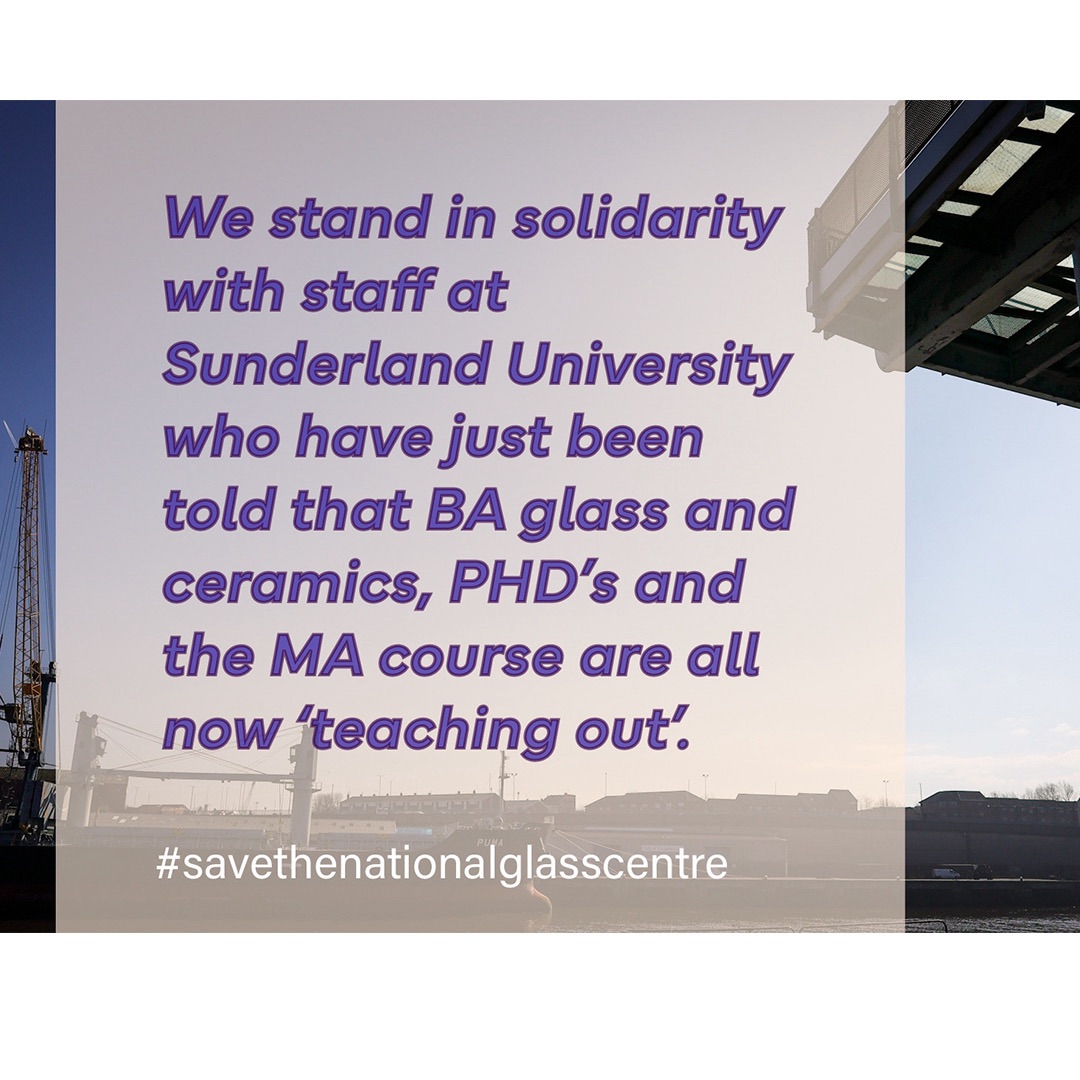
This apparent “managed decline” of the NGC as a visitor attraction has been compounded by the lack of support for, and promotion of, the glass and ceramics academic courses leading to a climate of uncertainty. The offer to students has been weakened so that numbers will fall, and the courses will be cancelled, resulting in the permanent loss of vital material knowledge and expertise: glass is a sustainable, future facing material, not an anachronism.
Now after over a year there is no definite plan to relocate the many and varied activities that take place within the NGC. Half-hearted attempts have been made to relocate the NGC gallery and the academic course facilities into two locations, an unbuilt new development and an old building on the other side of the river, neither of which can provide the required specialist facilities. There is no plan for glassmaking to continue anywhere. The University is a Founding Partner of the charity, Sunderland Culture, and glassmaking is written into its Charitable Objects, a fact that the Board of Governors appears to have completely ignored, or been unaware of, when making the decision to close (see Report pg 5 onward).
In October 2023, it was revealed that the University had decided that they were not in the position to ‘lead the charge’ on the creation of a new glassmaking facility (University Internal update) thereby threatening the purpose and assets of a charity.
When is the University going to acknowledge that the NGC is a public asset run by a charity, with millions of pounds of embodied public funds invested in its creation and maintenance? Its inauguration in 1998 was not just about creating a visitor attraction or an asset for the University to dispose of as it wished. The NGC was, and still is, essential to the regeneration of Sunderland after the years of economic decline led by the demise of heavy industries. According to the Seven Principles of Public Life, as “public office holders” the Board of Governors have a duty to act as “…servants of the public and stewards of public resources” and “…act solely in terms of public interest.” The obligation is to “…act and take decisions impartially, fairly and on merit, using the best evidence and without discrimination or bias.” And to be “…accountable to the public for their decisions and actions and must submit …to the scrutiny necessary to ensure this.” You must be aware that there is an online petition to save the NGC which has a wealth of public opinions. If you are in any way unclear as to what people think about your decision read the Report (pg 20 onwards).
Change needs to happen. There is no reason why the NGC cannot be placed on the path to a sustainable future if given the backing of organisations with the expertise, enthusiasm and commitment to effect real change. The campaign to # Save The National Glass Centre have amassed a wealth of evidence and a network of highly skilled supporters ready and able to contribute to a positive outcome for
Sunderland, our children, visitors, the creative community and world-wide glass artists. All that is needed is for the Board of Governors to abide by the Seven Principles of Public Life, review their decision making and start a dialogue with the public over our National Glass Centre’s future.
On behalf of #Save the National Glass Centre, we would welcome the opportunity to meet face to face and if you require any clarification, we are more than happy to oblige.
We await your response with anticipation.

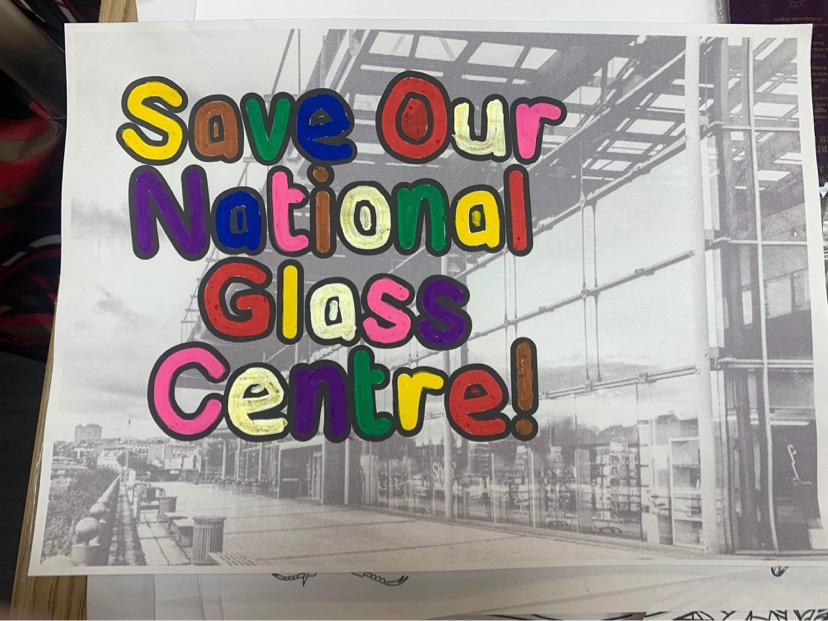
 Save the National Glass Centre