Apollo Magazine Article

By Emma Park

Click the link below to read the article ❤️❤️❤️

https://www.apollo-magazine.com/national-glass-centre-sunderland-closure/

#SaveTheNGC

25 years of the National Glass Centre

A brief history of the National Glass Centre Building

by David Vickery, retired senior planning inspector

The National Glass Centre (NGC) celebrates its 25th anniversary this coming October under threat of closure and likely demolition. It was opened by HRH Prince (now King) Charles in October 1998.

This amazing building lies on the north bank of the River Wear on the former site of the J.L. Thompson and Sons shipyard, facing the mouth of the River Wear and Sunderland’s port. It is close to the site of St. Peter’s Church, built in 674, where Abbott Benedict Biscop instructed French craftsman to glaze its windows, starting Sunderland’s long connection with glass making.

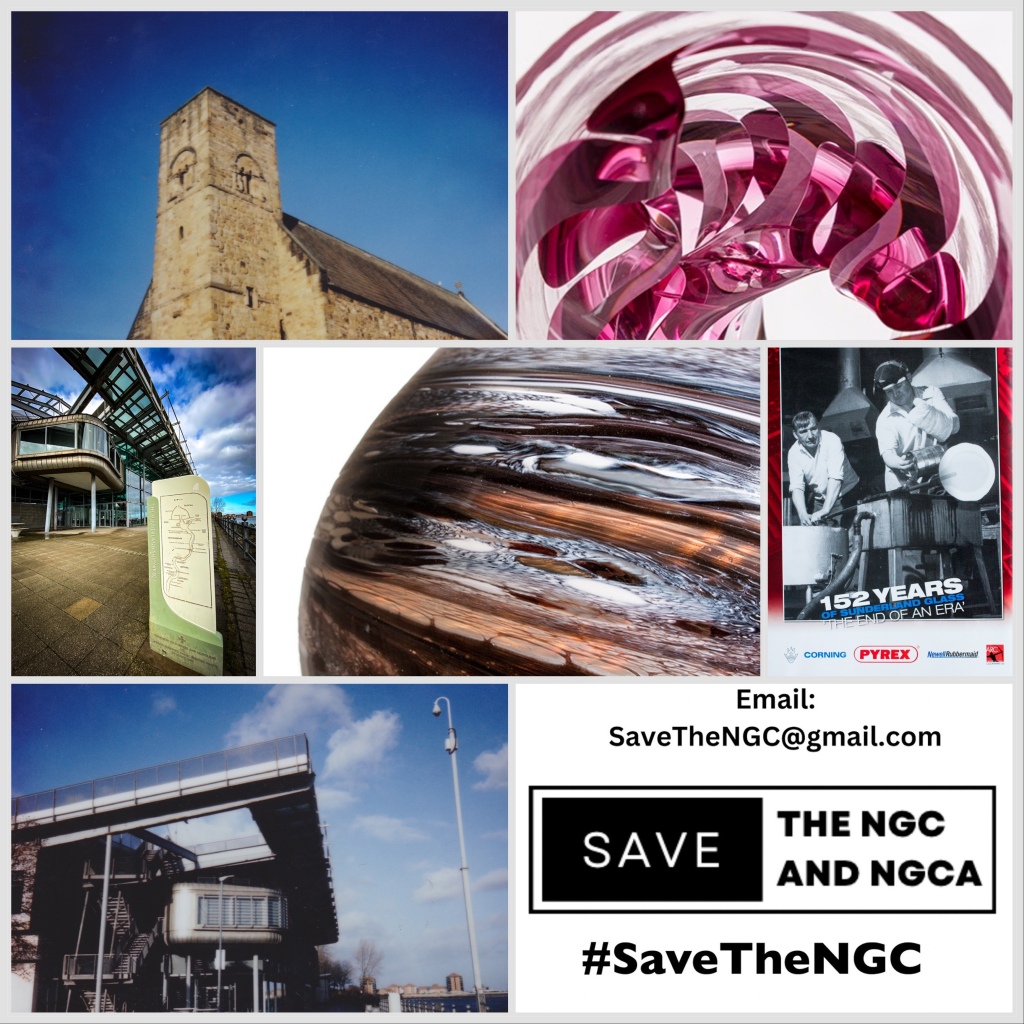
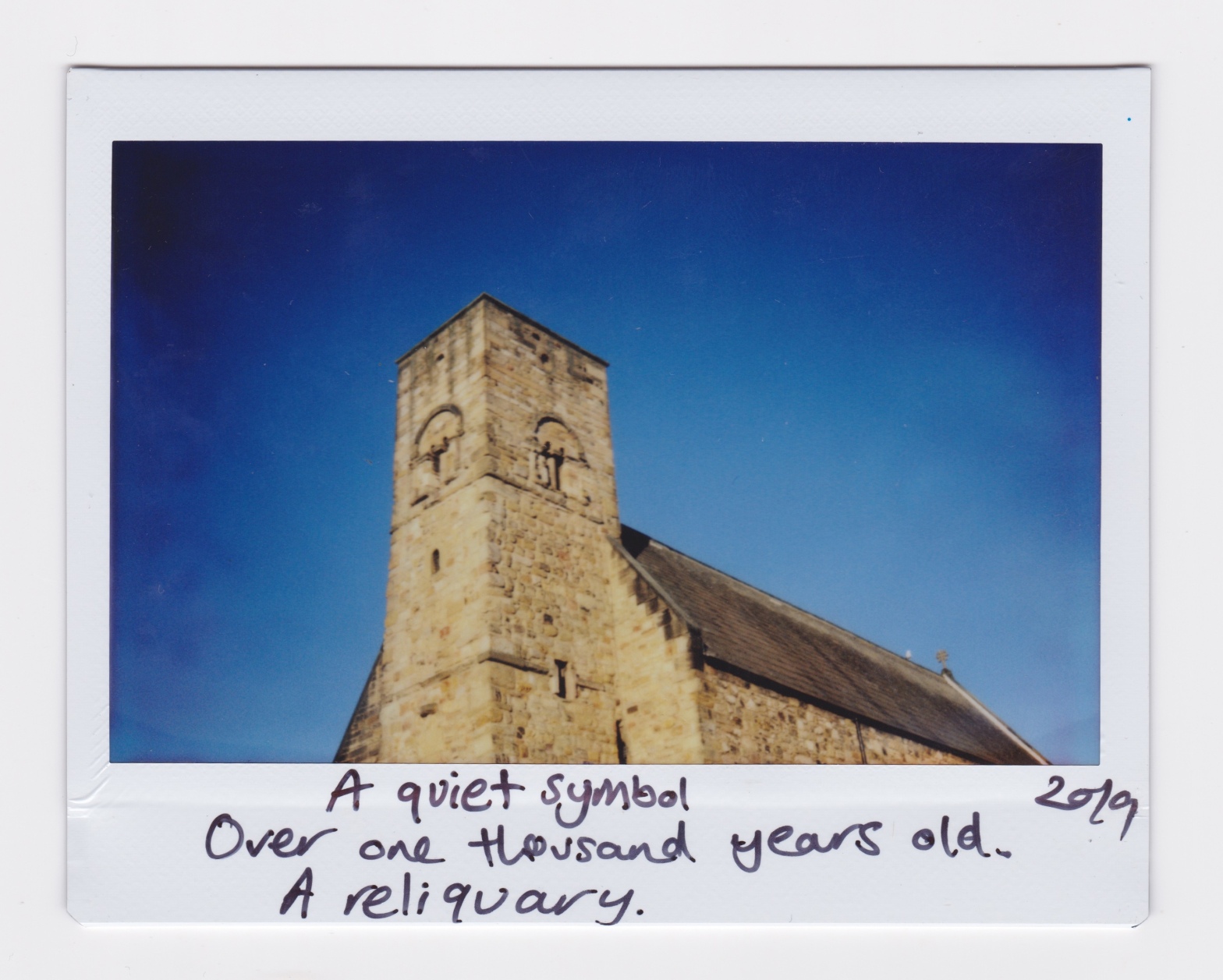
Instax haiku about St Peter’s Church, photo by Jo Howell 2019

In 1994 the Tyne and Wear Development Corporation held an open competition for the design of the NGC, with the objectives of celebrating the heritage of glass making in Sunderland and to support the development of new glass production for the 21st century. This competition, with over 80 entrants, was won by the London architectural practice GolliferAssociates Architects (now Gollifer Langston Architects). Their proposal aimed to make the activities and production going on inside the building visible to visitors.

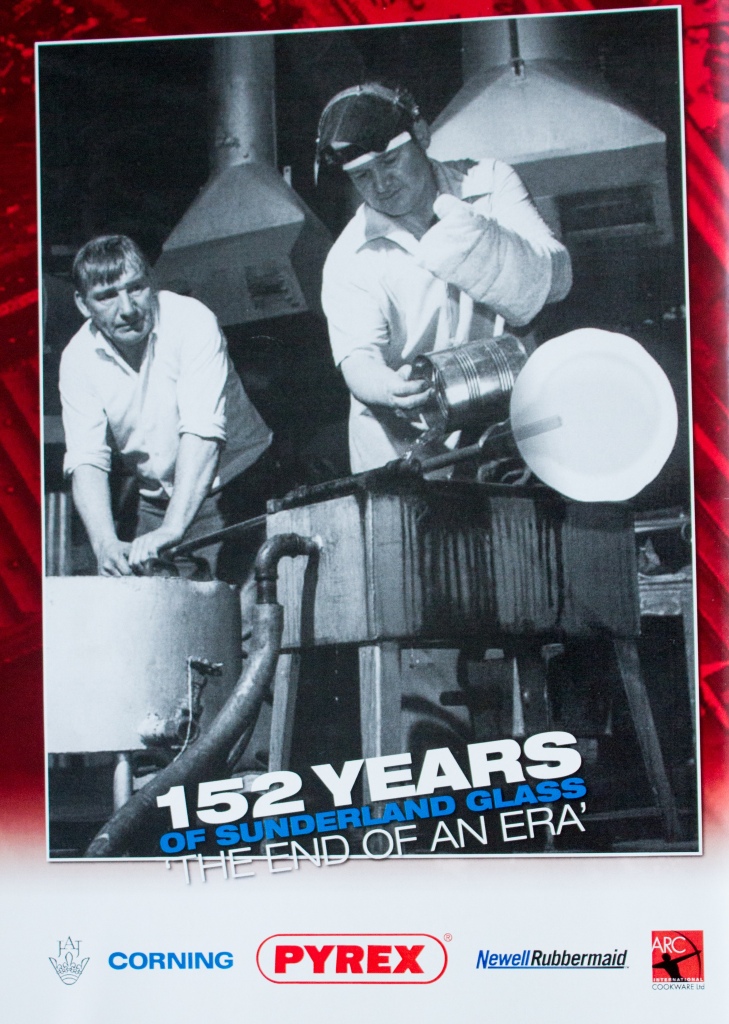
Front cover of Pyrex magazine, courtesy of Tyne and Wear archive, scanned by Jo Howell

The NGC was the recipient of the first major Arts Lottery Award in the North East. It was also funded by the Arts Council, the University of Sunderland, Tyne and Wear Development Corporation, the European Regional Development Fund and Sunderland City Council.

The building was one of the first in Sunderland to mark the beginning of the city’s regeneration, breathing new life into the depressed docklands area.

The complex design incorporates all the various uses into a glass envelope, supported by an exposed steel shell. The industrial finish looked striking and unusual when it opened in 1998, and it still does so today.

The NGC almost looks as if it is leaning towards the water, like a ship being launched. This is because the architects wanted the building to resemble a sea-bound vessel.

The building is built into the slope as the land runs down towards the river, with the public areas located to the south looking onto the riverside. The “back of house” areas are located to the north of the building, built into the slope.

Along the riverside the building has a long length of tall steel and glass walls, with an overhanging glass roof, exposed steelwork and external stairs.This modern, bold design means the NGC is instantly recognisable from the riverside public footpath and from the opposite river bank.

Inside, the high glazed walls and roof, mezzanine, open stairs, exposed steel work and ducts, and a concrete lift shaft give the visiting public a uniquely open, futuristic, brightly lit experience with views through the glazing to the river beyond.

The building looks fantastic when it is lit up at night, with light streaming out through the huge glass walls and roof.

The building was awarded Millennium Product status by the Design Council in recognition of its creativity and innovative environmental approach. It was one of the first buildings in the UK to use an earth tube to bring pre-cooled air into the public areas while the excess heat from the factory was recovered to heat public areas in the winter months.

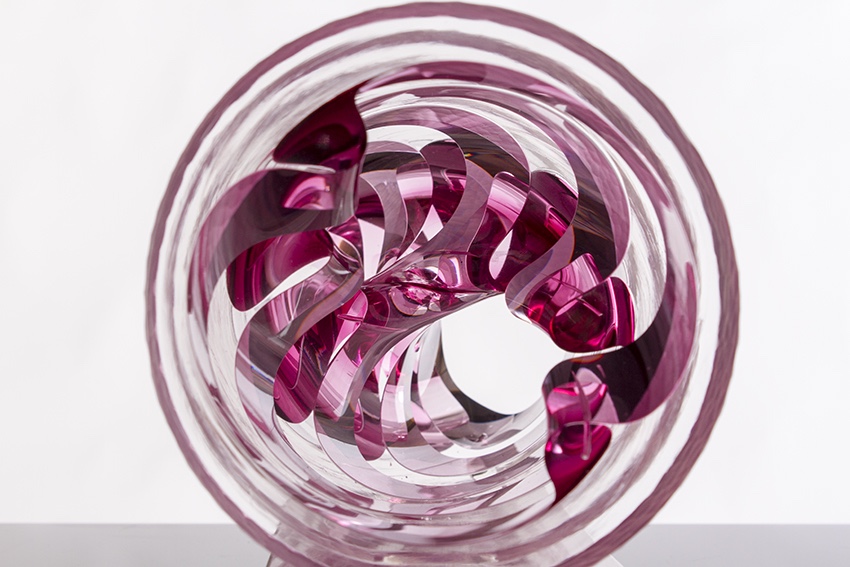
Detail of Phil Vickery blown glass made in the National Glass Centre hot shop, photo by Jo Howell

It cost £7.2m to build in 1998, and was “revamped” by the University in 2013 at a cost of £2.25m with a new gallery, restaurant, remodelled glass studio and shop.

It is open to the public, and around 230,000 people visit it each year, making it a major cultural venue and visitor attraction in the north-east. So go and see it while you can…

The National Glass Centre Grief to a Smile – My Journey by Derek Newton Lynch

Derek Lynch Website


How might you ask? Well let me tell you a story…...

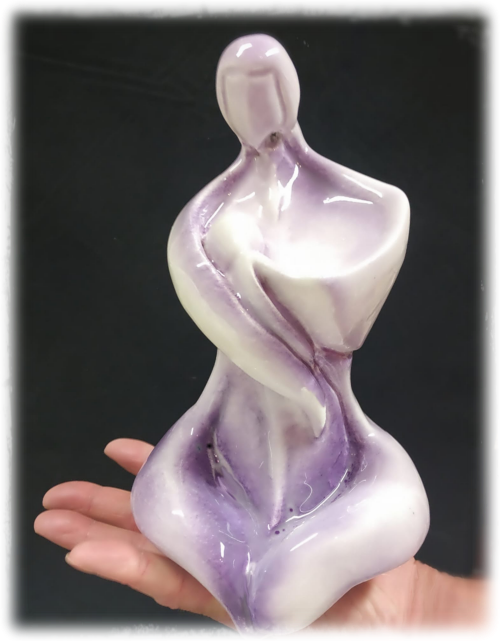
I make ceramics, I’m not a well-known artist, I don’t sell anything, I don’t make money from it and my career was in computing as an I.T. Manager. 

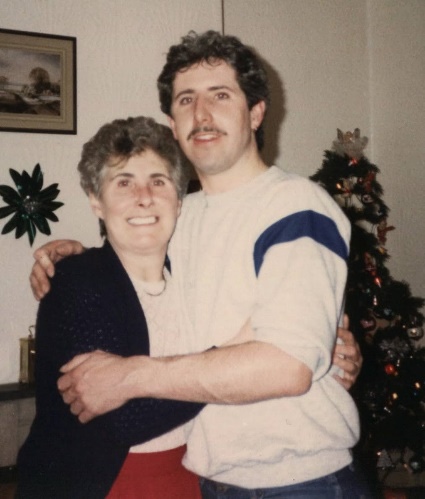
Sadly, my ceramics journey started with someone’s death. It wasn’t just anyone’s death but my mother’s my “Mam” as we call them in the North. 


In 2001 my Mam suddenly passed away. The shock and loss of a parent is always hard to cope with and I wasn’t doing it very well at all and I was at a loss at how to stop feeling so sad all of the time. 

My life at that time was basically go to work and solvecomputer problems, then come home and just think about missing my Mam. There seemed to be no way out of the sadness I felt. This couldn’t go on and after a few weeks of this misery I decided something had to be done and I needed to break the cycle. 


I thought perhaps an evening class would give me something to occupy my mind. I saw a Ceramics class advertised. Not only had I never done pottery before, but even better the course was free. I went along with some trepidation, thinking what have I signed up for?” After all, I considered myself to be a “techie rather than an artist.

In the class I was seated with 4 fantastic ladies who were around the same age as my Mam and they laughed and jokedthe whole time. They reminded me so much of my Mam, but in a much happier time. 


They brought laughter back into my life and the sudden realisation that I enjoyed ceramics helped me to cope with grieving for her, by remembering the good times rather than her death. Suddenly life seemed a whole lot better. 

More importantly, every time I started making a ceramic piece it always reminded me of my Mam. 21 years later it still doesand I have a huge smile thinking of her. 

After a while I signed up for even more evening courses but this time at the National Glass Centre. Wow I was so overawed at their facilities and couldn’t believe I was making things there, me a mere hobby potter. 


How proud I was that I was not only going to a centre of excellence but even more than that my Dad had been a “Plater” at the very shipyard which was situated on the site of the National Glass Centre. Even he was proud of me, a tough no-nonsense northern shipyard worker was impressed with his son’s creations,

what a surprise in my life. 


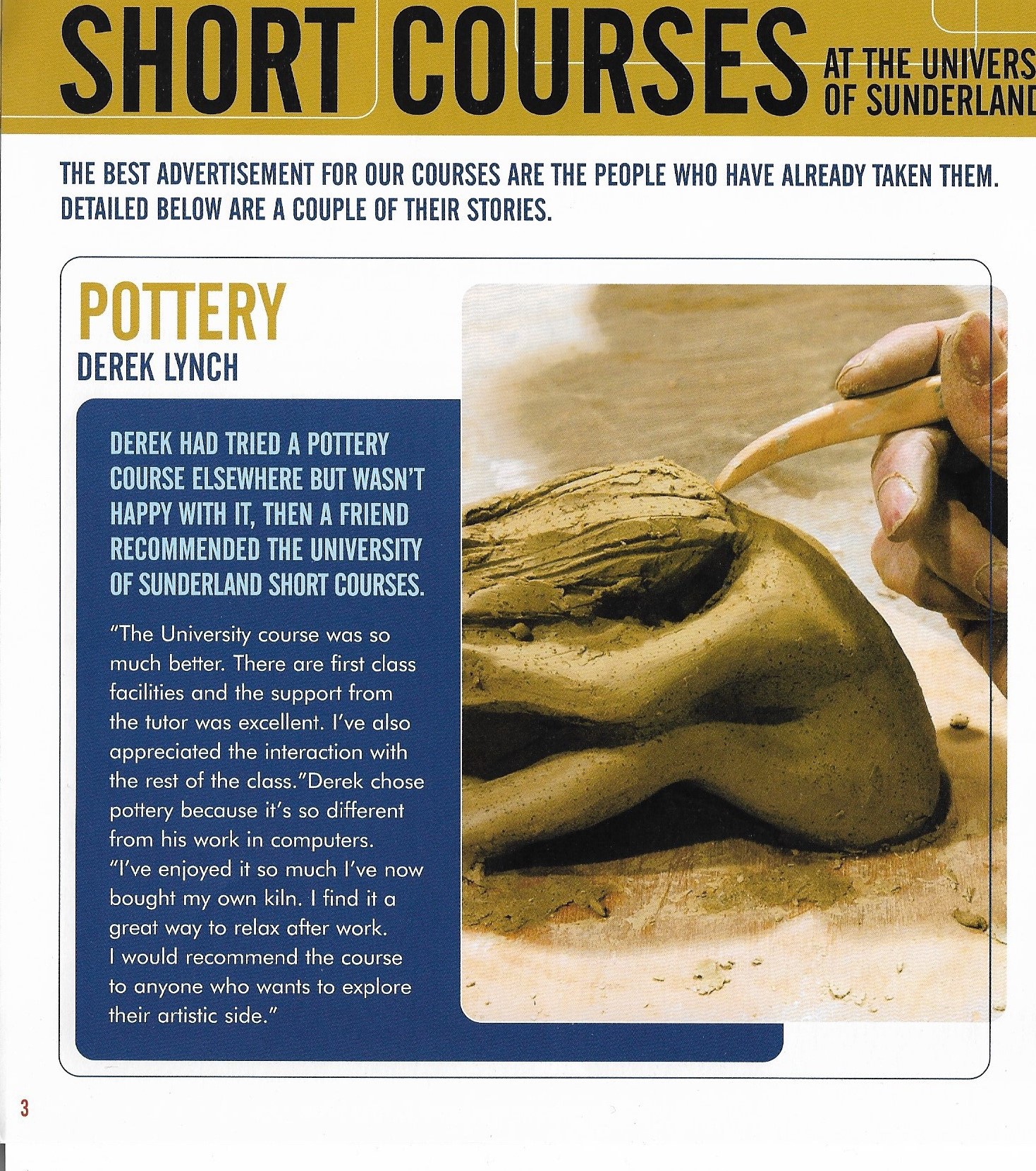
I even managed to appear in the University’s learning booklet.

The professionalism of the staff teaching me, the chance to meet other students at the Glass Centre and being able to see what I could achieve eventually led me to purchase my own kiln. Contacts I made on the courses also led to the purchase of my first pottery wheel. 

Every time I either make a ceramic piece or look at the many pieces either in my house or the homes of people who have my art, I think of my Mam. Not with sadness but with a hugesmile and I say thank you to her.


So, this story isn’t really about me it’s about my Mam, who sadly never got to see any of my ceramics or my journey from an evening class in a little school through to the country’samazing National Glass Centre.

The National Glass Centre was key to changing large parts of my life, all linked with someone sadly passing away and enabling others to smile when they receive a piece of my amateurish pottery, who would have thought it!! 

My career was in computing, did I like it, well yes but my soul is in ceramics, do I like it, just ask my Mam she knows.

This is why all of my ceramics are dedicated to her.


#SaveTheNGC #SaveTheNGCA

Do you have a story about the National Glass Centre?

Has it changed or improved your life as well?

Write to us! We would love to share it here.

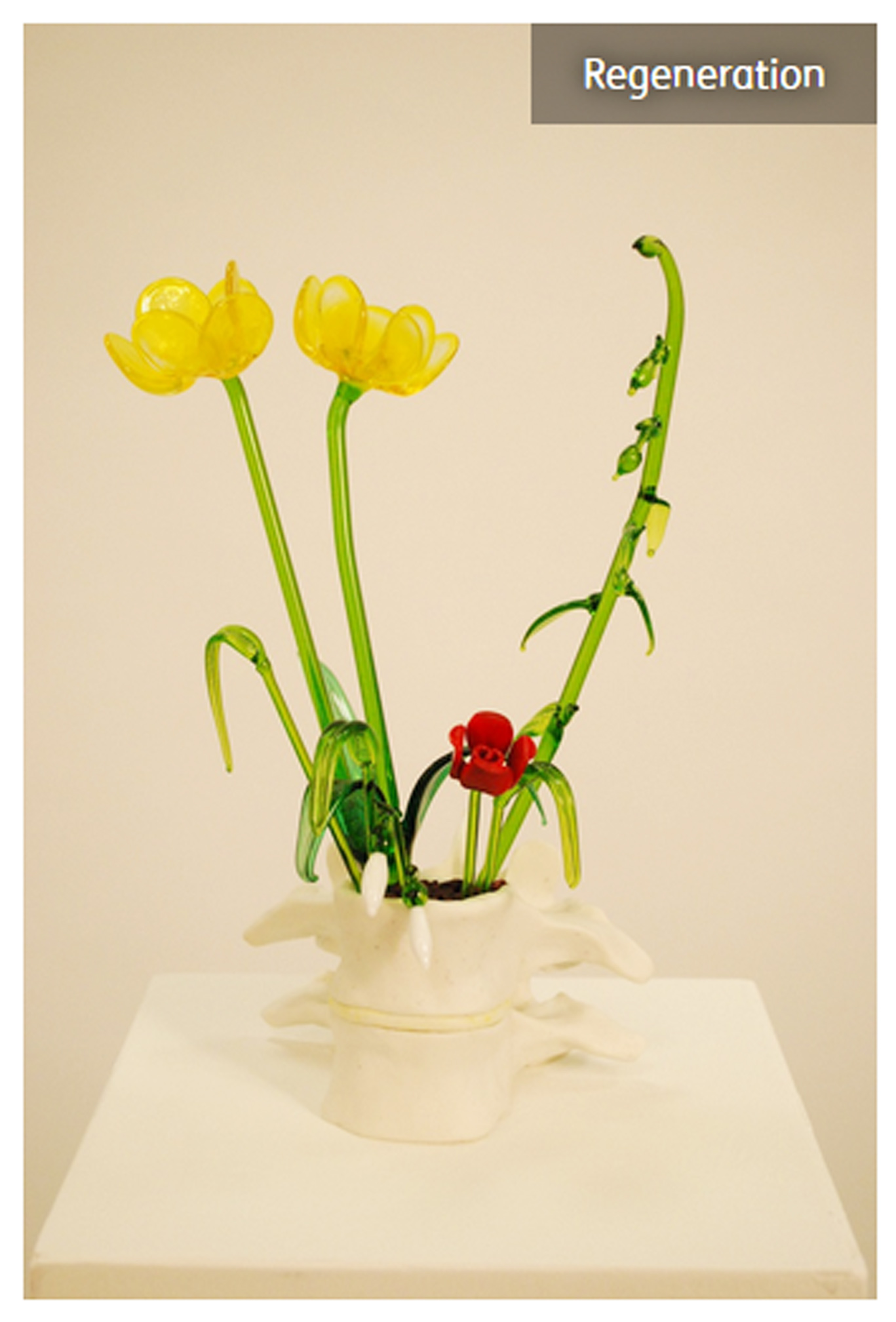
Regeneration: An artist’s journey with the National Glass Centre

Gary Nicholson, Artist

After the stinging news that the National Glass Centre (NGC) is under threat of closure, many people have come forward to share their memories and concerns for the future of glass in the City of Sunderland. Here are my thoughts.

In 2012, I arrived at the NGC to do a Foundation Degree in Art and Design. I made friends and lots of good memories. I went on to do a B.A. (Hons) Illustration and Design, then an M.A. Design (Illustration) on the University of Sunderland’s City Campus. In fact, I returned to the NGC to work with the technicians on some glass sculptures for my final exhibition. In January 2018, I founded Regeneration NE Community Interest Company with my long-term friend, who himself studied Ceramics at the NGC.

In 2019, The Art Studio, a mental health charity in Hendon, closed down due to lack of funding. Having volunteered and worked as a tutor there, regular service-users, who were living with serious mental illness looked to me and Regeneration NE for help. It was the NGC where we would meet up, have a coffee and perhaps do some sketches overlooking the river.

Above: The glass sculpture, Regeneration 2017, created by Gary Nicholson at the NGC.

Among the meeting rooms in the NGC, I attended Artworks-U Networking and Support meetings which gathered local artists to discuss projects, problems, new ideas and potential collaborations. It was a safe place for new graduates like me to watch and learn from more experienced creatives who travelled from across the region to be there. Kids and families often head over to the building to see the exhibitions and amazing glass-blowing demonstrations as an educational and cheap day out. Local artists can also hire the facilities to create and run their businesses. You can even buy affordable and unique glass pieces created by the artists on site.

The NGC is a landmark and a place of education, history, heritage, community and culture. It links modern Creative Industries with the City’s proud industrial past. It has impacted the local economy by attracting students who want to study Glass and Ceramics. In the past 10 years, other universities have dropped Art, Glass and Ceramics courses from their prospectus, (e.g. Falmouth, Kent, Roehampton, Wolverhampton), which makes the dedicated centre for the tuition of Glass and Ceramics all-the-more precious at a national level.

It’s true, sentimentality won’t pay the NGC bills. However, the same Sunderland people had the self-belief, business and creative expertise to be shortlisted for City of Culture 2021. Regeneration NE urges them to now work on saving the NGC. It will be a logistical and safety nightmare to squeeze everything into shared spaces in the City Centre. It would be just plain wrong to let it slip away without a fight.

Gary Nicholson (Artist).

Director and Co-Founder of Regeneration NE.

email: regenerationnecic@gmail.com

Regeneration NE uses art as therapy to support better mental health and wellbeing in the community.

Sunderland Echo article and comments

Please click the link below to read the Sunderland Echo article.

Sunderland Echo Article

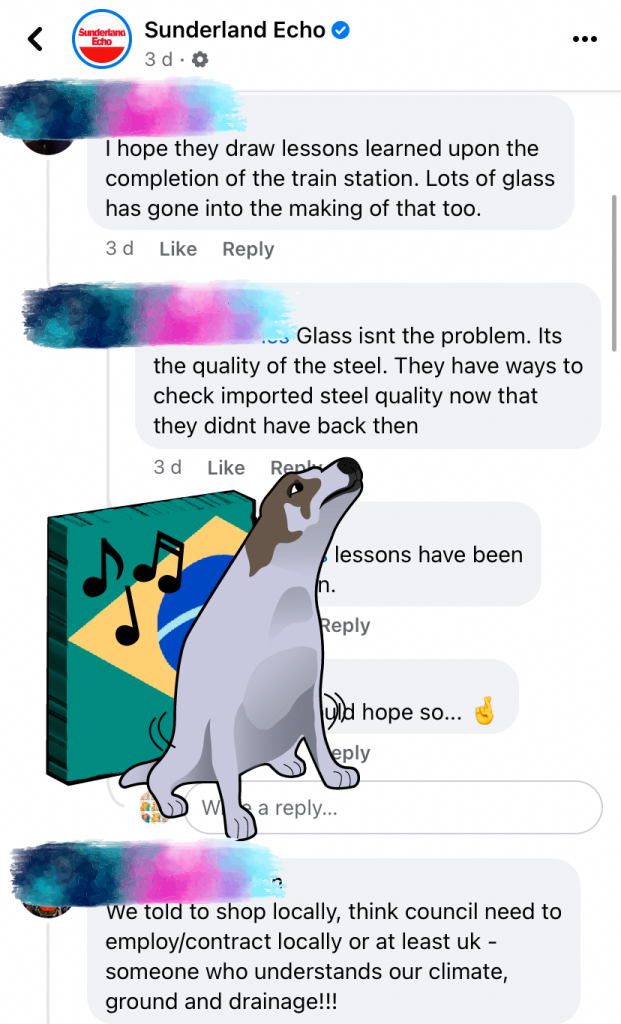
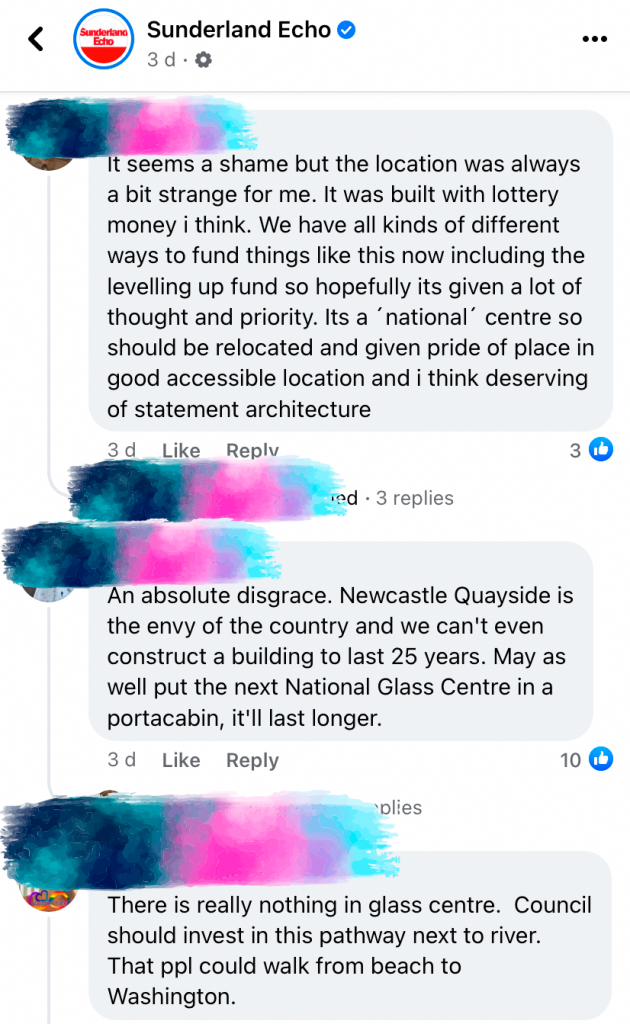
Comments on Facebook on Sunderland Echo
More FB comments from the Sunderland Echo Article