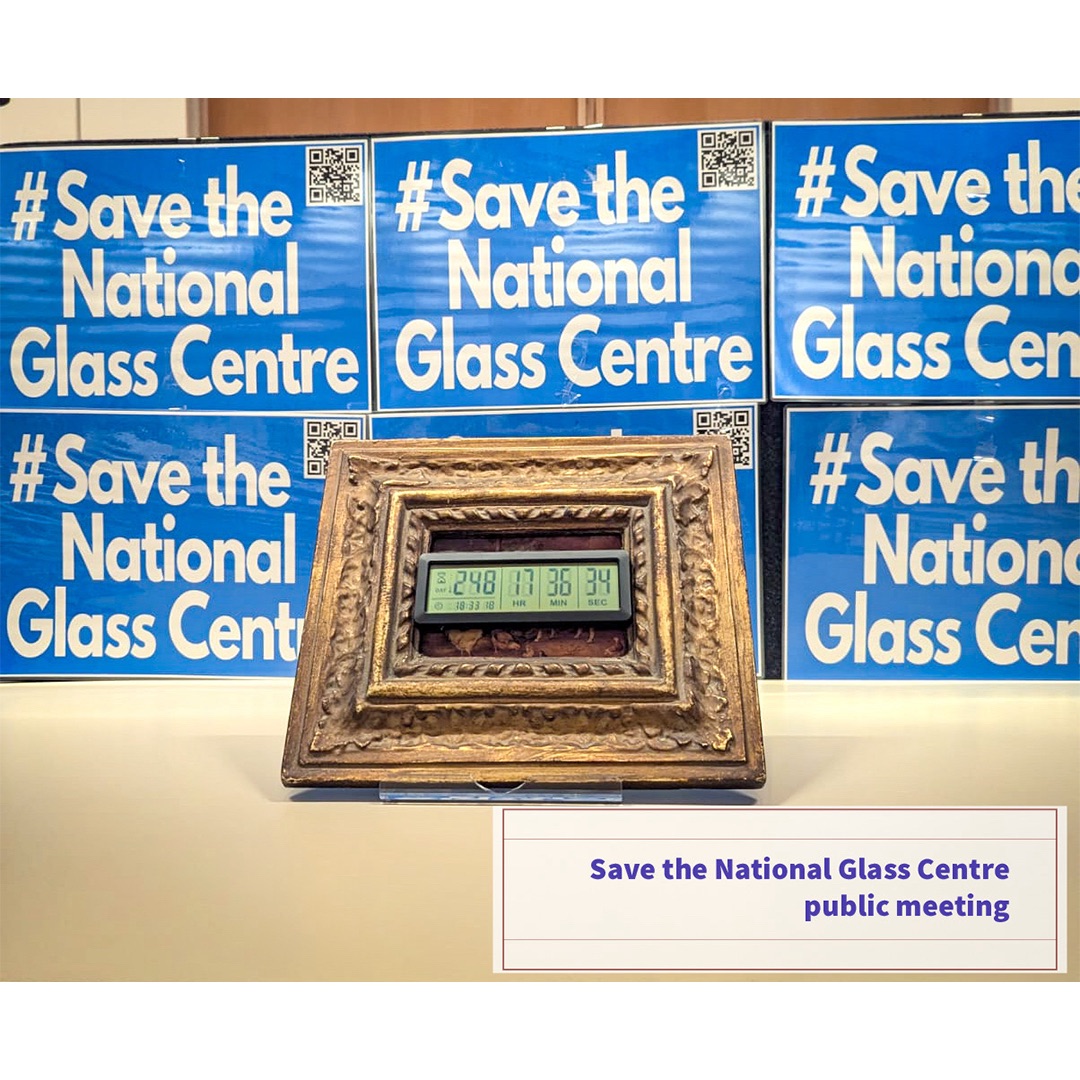
thanks for your support. On Wednesday, 25th March, Sunderland City Council will debate a motion which could help to pause demolition and save the National Glass Centre. If you still feel strongly about this, please could you write to your local councillors and MP to express your concerns. This will help the campaign enormously. If you live in Sunderland, consider attending the council meeting in person (4pm at City Hall, Sunderland) to show the strength of public feeling.
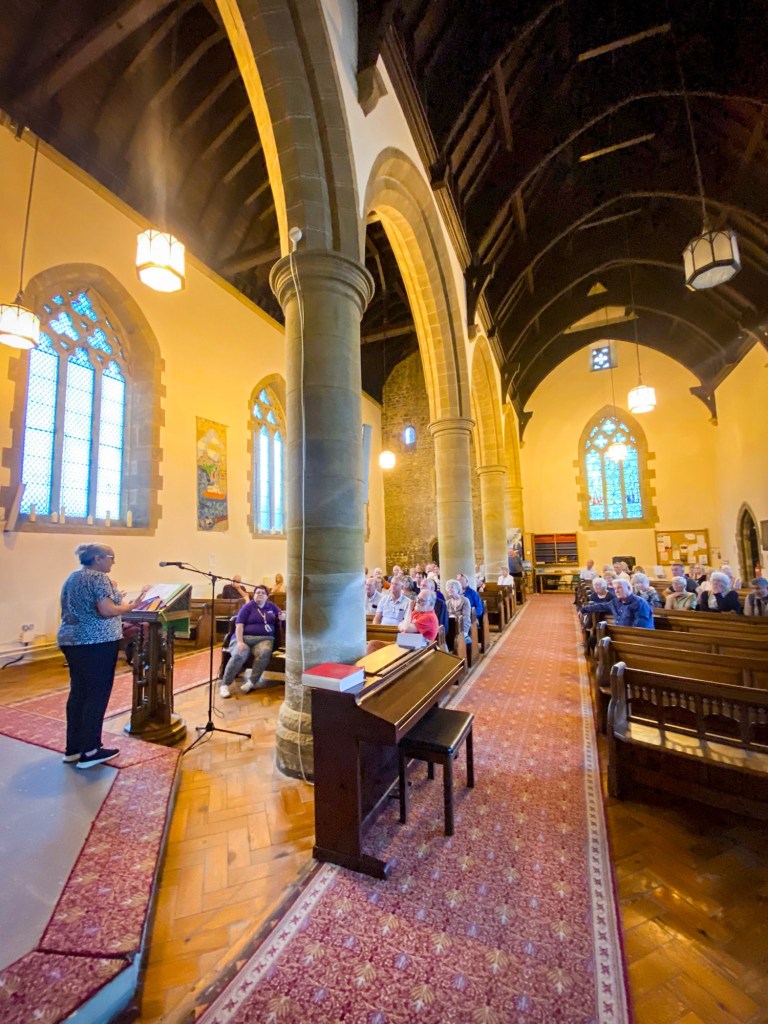
Glide around St Peters church, the birthplace of stained glass once the Romans left. Video by Phil Vickery
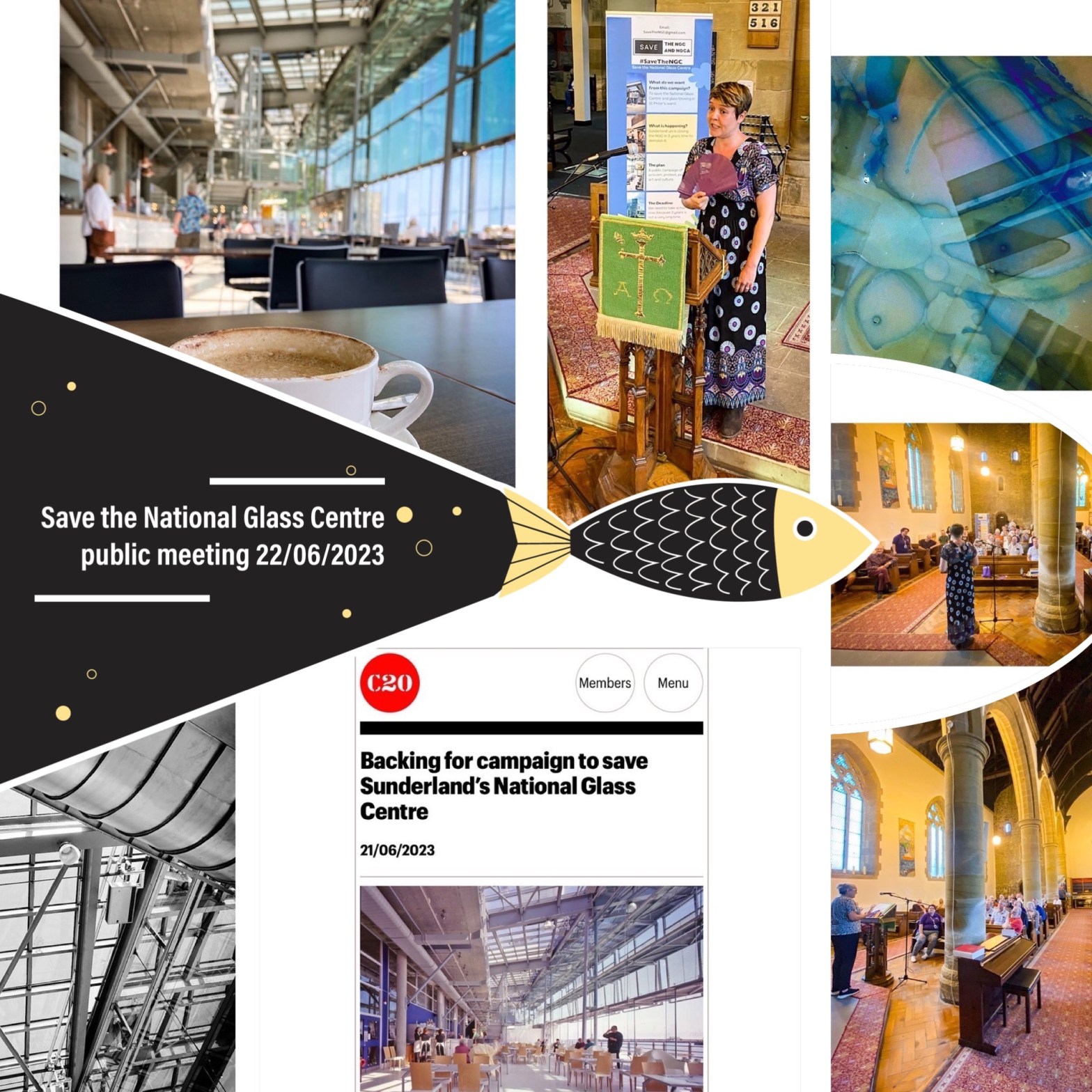
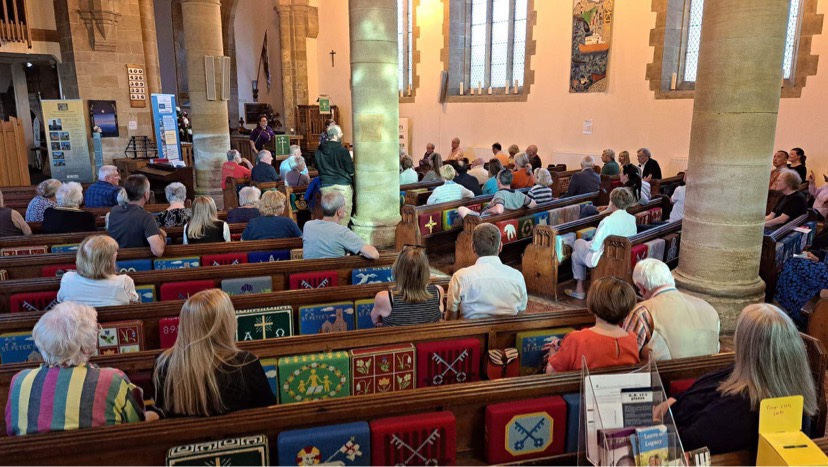
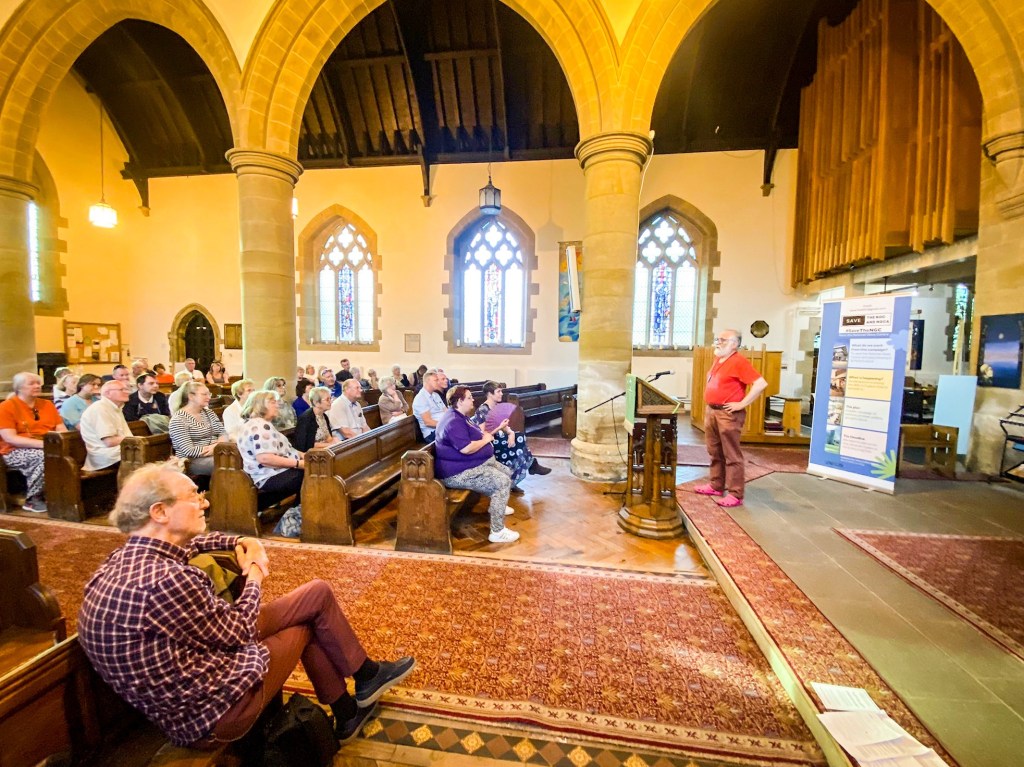
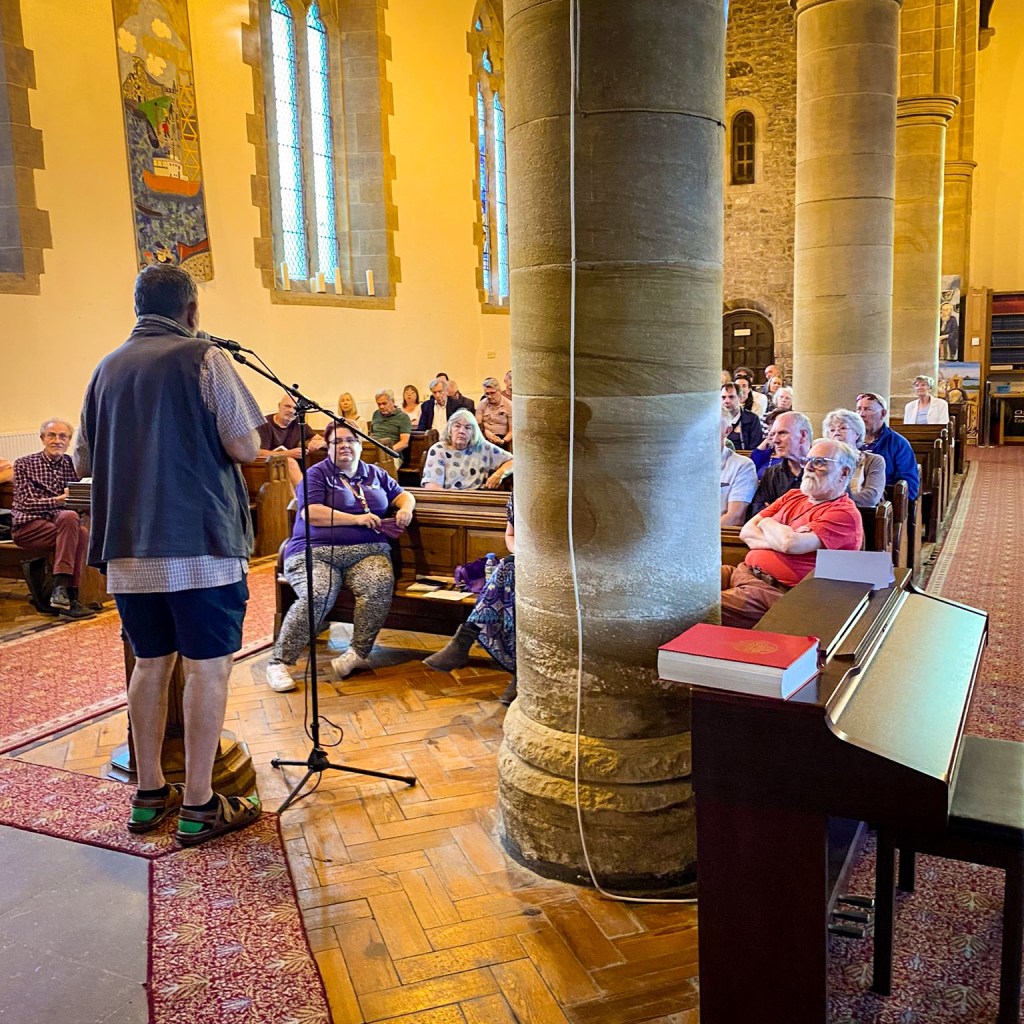
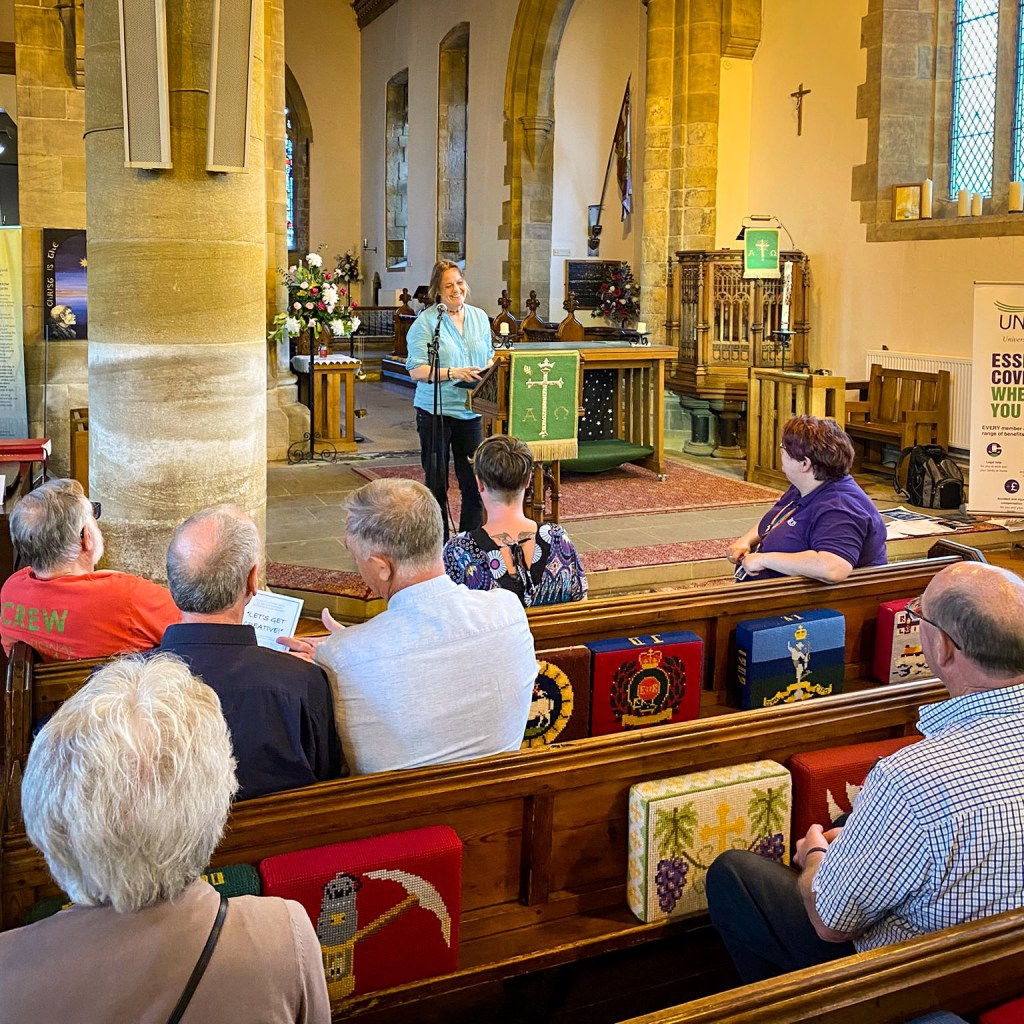
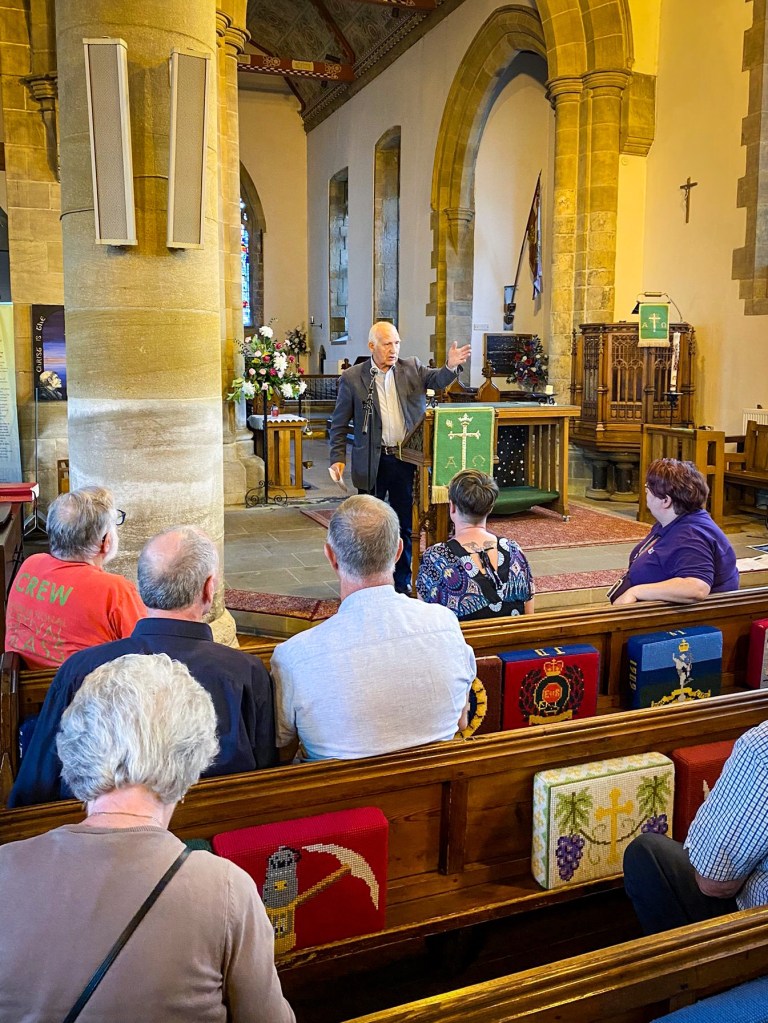
On a balmy summer night on 22nd June 2023, Sunderland citizens came from all across the city to St Peter’s church. This was the first public meeting of the save the National glass centre campaign. We had 30 people book through our eventbrite, but closer to 100 actually attended.
During the week I had visited Sunderland central MP Julie Elliott. I had invited JE to the meeting, but unfortunately she was busy. After an hour of conversation it was clear JE could support the fight to save the essence of glass making, but was adamant that the building of the National Glass Centre had not been beneficial for Sunderland, and that we should support the University line. I requested a statement for the blog. This is still pending.
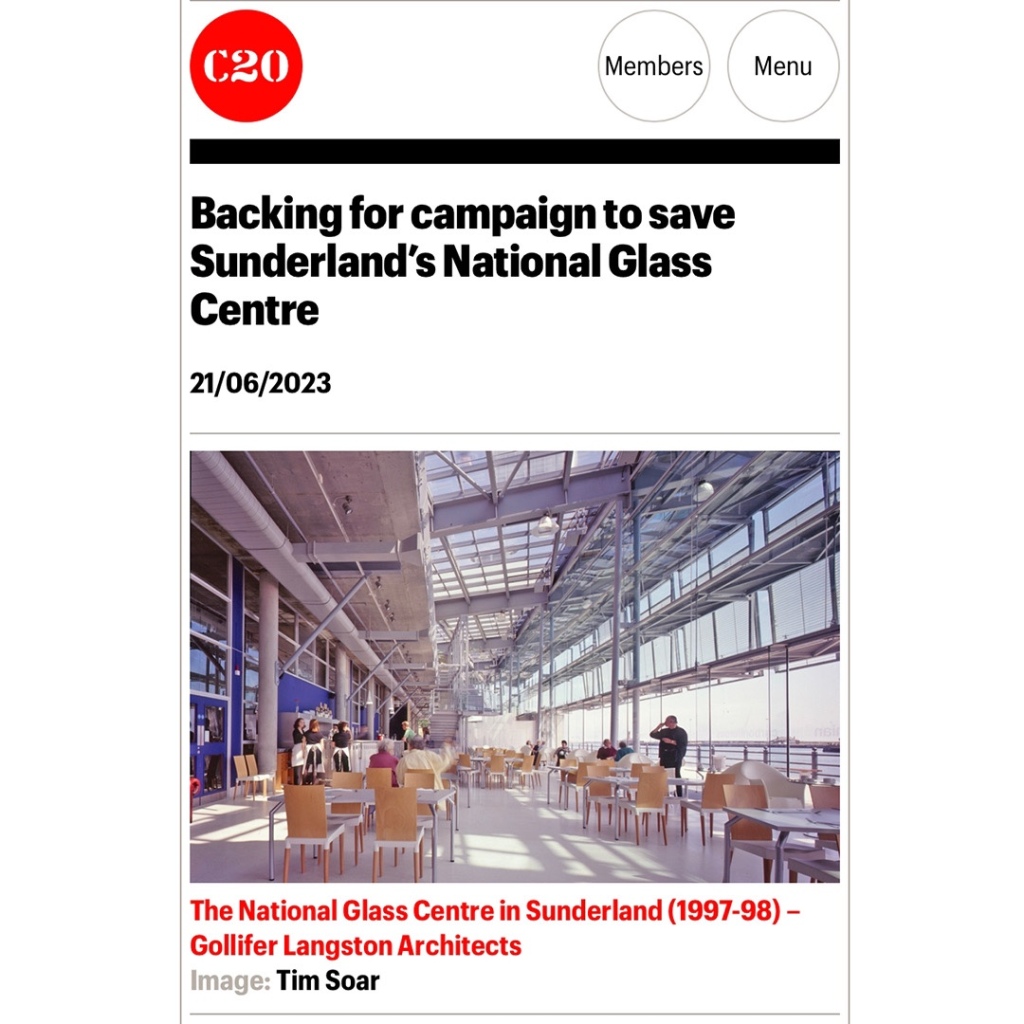
On the day of our meeting the 20th Century Society, for the protection of at risk 20th century buildings, wrote a fantastic article in support of our grassroots campaign. More support and much needed publicity. You can read their article here:
I also met with senior management from the University to further question statements made in the report. The estates manager confirmed that recent work to remove the metal from the riverside of the glass centre had resolved structural integrity problems.
Furthermore, the services like the heat exchange, furnaces, and utilities systems are all nearing end of life. I have requested further information about the ‘end of life’ equipment. As I believe this will be a key factor in exactly what is saved.
Photograph by Chris Howson
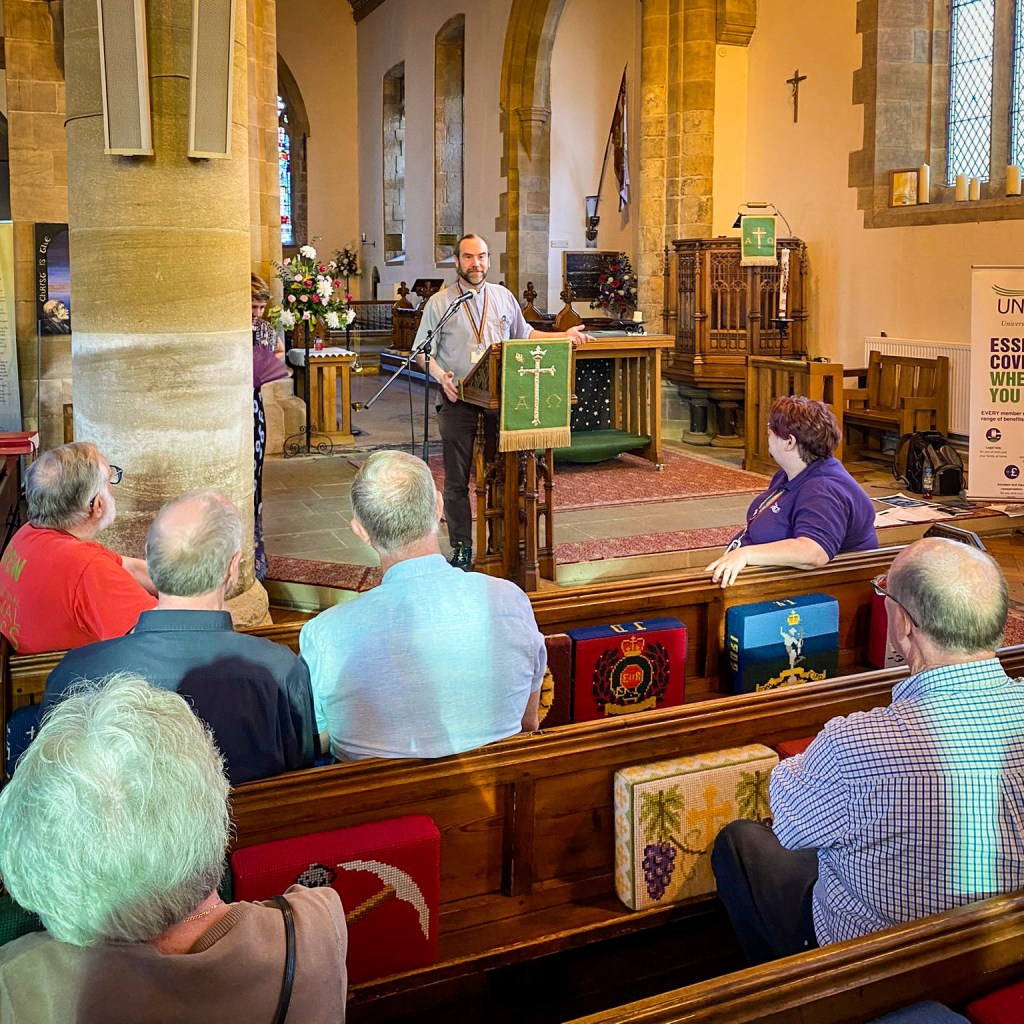
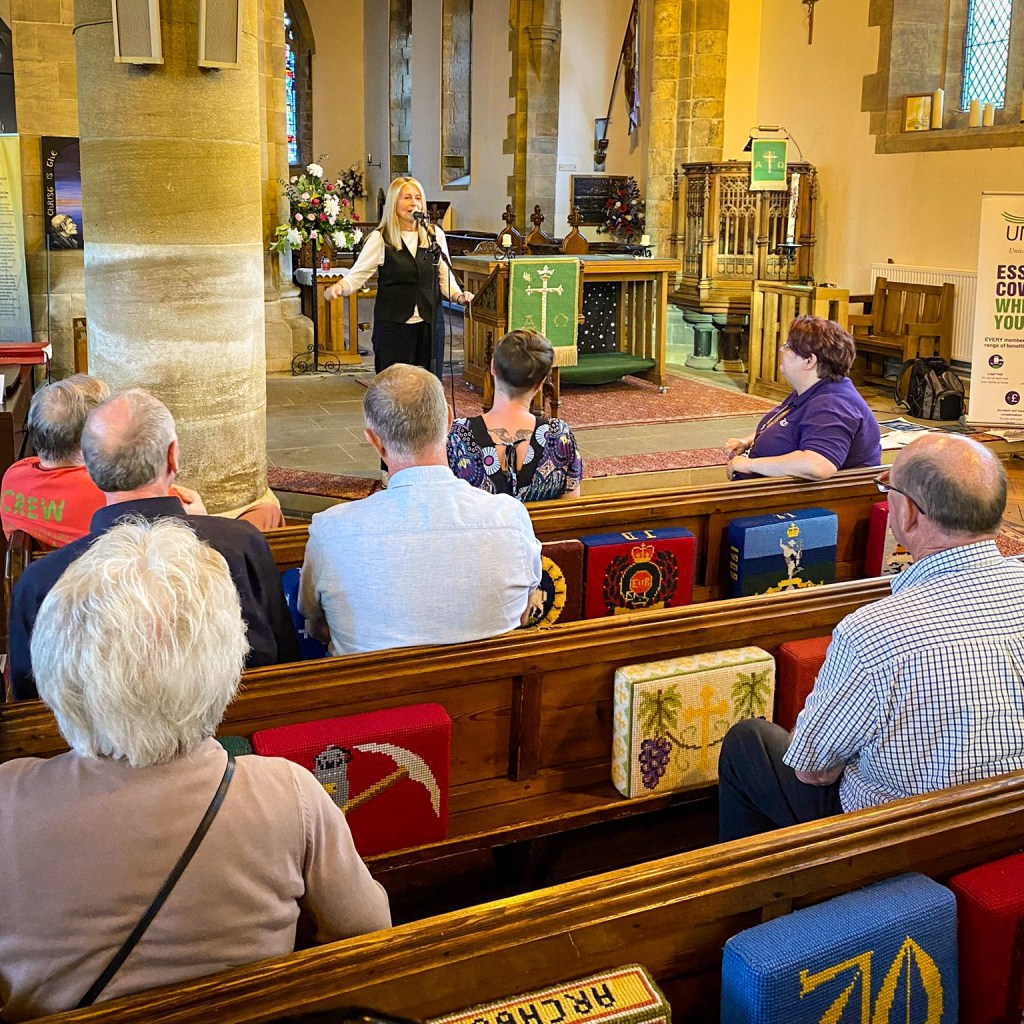
We had a lot of passion in that church during our public meeting. Emotions were running high. The awesome setting struck a cord with all of us. How tragic it would be to end 1350 years of glass making tradition in the North East? There were tears, there was laughter, there was unity, there was outrage, and there were outpourings of love from every speaker.
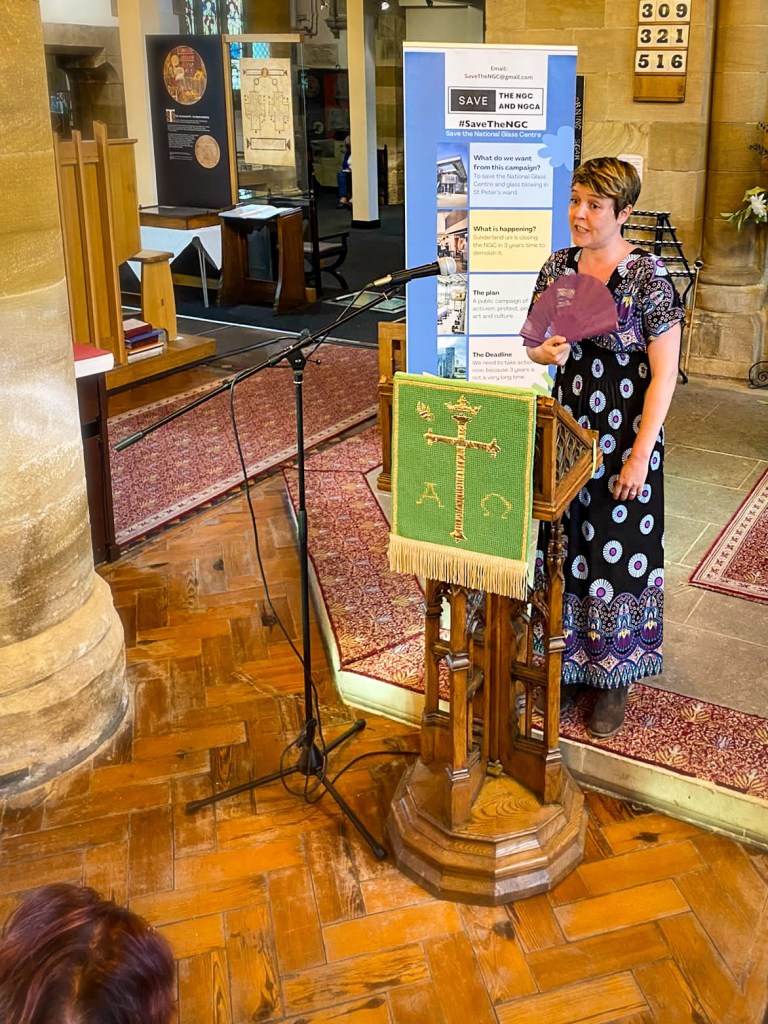
Jo Howell: Photo by Phil Vickery, glass blower
I opened the evening with a brief introduction to who I am, what we’ve managed to achieve in the campaign so far, and a statement provided by Sunderland University.
See below:
“The University has always been clear that the search for a new home, or homes, is an opportunity for the National Glass Centre’s work to reach new audiences in a financially secure and sustainable manner, rather than just seeking to recreate the status quo. Such future-facing work had already begun with staff even before the building issues made clear that a move was necessary.
“We remain in active and positive discussions with key partners, including Sunderland City Council, about future site options.
“On the future of the current NGC building and site, no decisions have yet been made.
“National Glass Centre and the Northern Gallery for Contemporary Art will remain open in the current building for the next 2-3 years, continuing to welcome visitors to a year-round programme of exhibitions and opportunities to take part in creative experiences.”
Katherine McLeod, Sunderland University, 22/06/23
Photo by Jo Howell
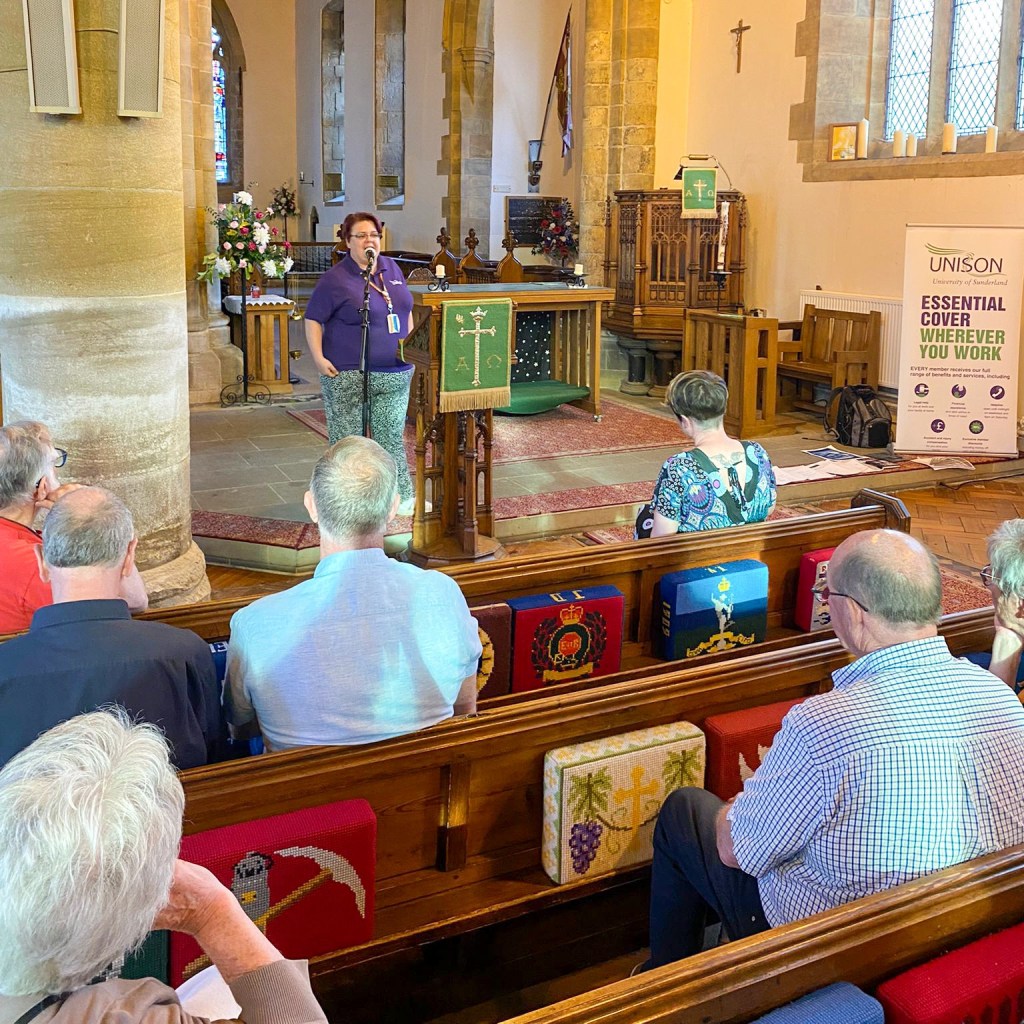
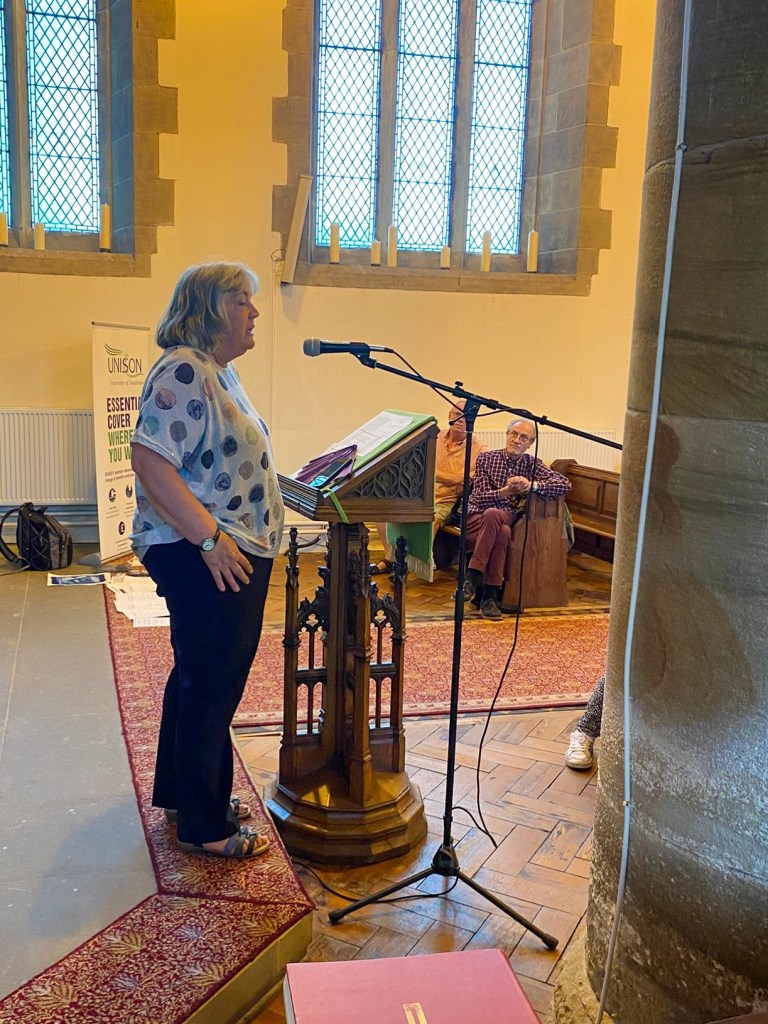
My quick introduction was followed up by Joanna Willets from Unison’s Sunderland University branch, who is in full support of the campaign on behalf of the staff; and she outlined why the unions are United with us.
Unison have put £500 into the campaign to support advertising, printouts, and other campaign costs. Joanna invited people to unionise, and explained how morale across staff in the national glass centre was fairly low due to the immense uncertainty around the future.
Joanna Willets: Photo by Phil Vickery
Chris Howson took the microphone for a moment to express how much his own family appreciated the National Glass Centre. And, he told the crowd of a successful campaign in Bradford, where a building had been marked for destruction but a community show of love turned the tide.
We will be including some of these ideas in our future events. Unity and love will be our primary weapons.
It is accepted and understood that Sunderland University cannot be expected to financially carry a building that is no longer part of their academic vision. What was very clear from the meeting was that there was a strong desire for amicable solutions that ultimately would benefit the City and the University by transferring custodianship. It is clear that the building and its contents are viewed by Sunderland University as a financial millstone.
This dim view of the National Glass Centre is not shared by the people attending the public meeting. The main takeaway being that the National Glass Centre is fundamentally, globally and locally, an important cultural leader.
The National Glass Centre was created as a beacon of hope for the people of the river Wear when shipbuilding was finally killed off. And, it was very successful in providing people from all levels of the city’s population a route out of poverty and depression.
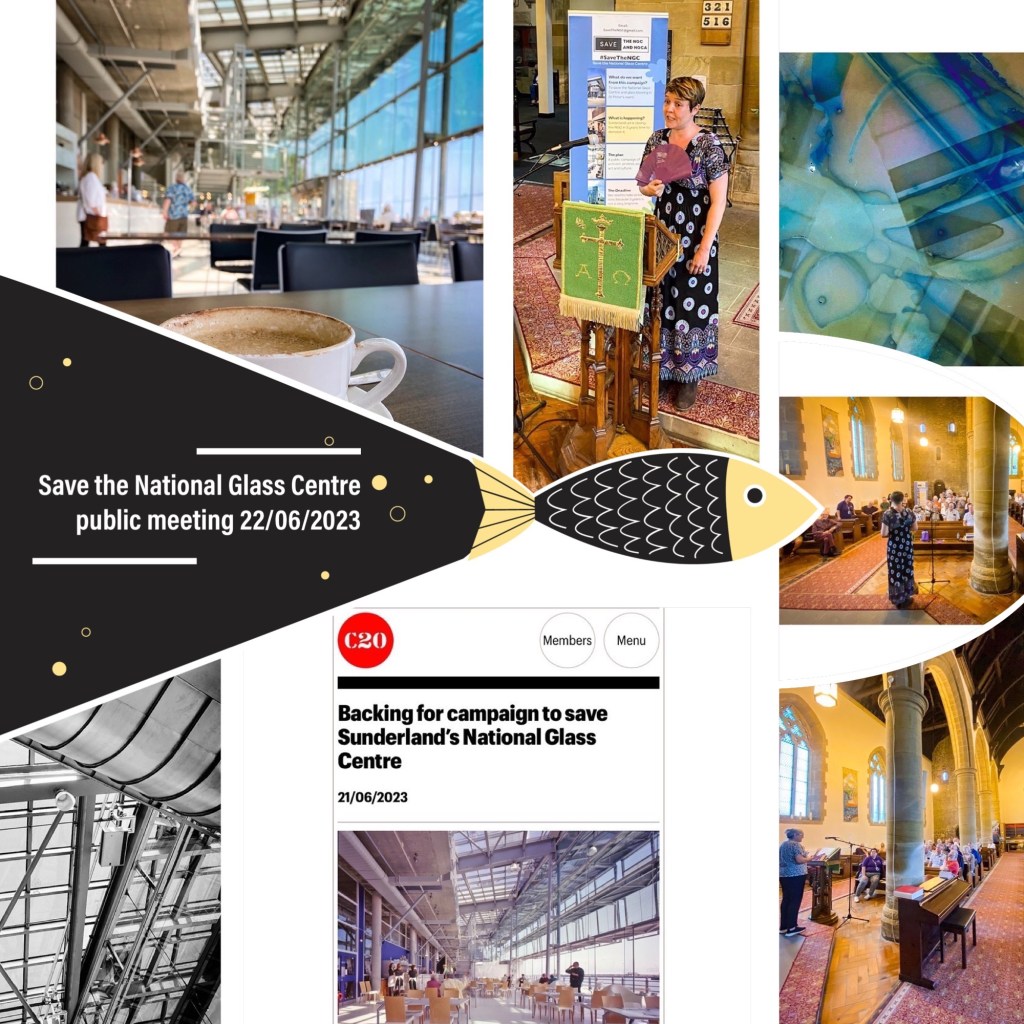
Save the National Glass Centre collage by Jo HowellChris Howson: Photo by Phil Vickery
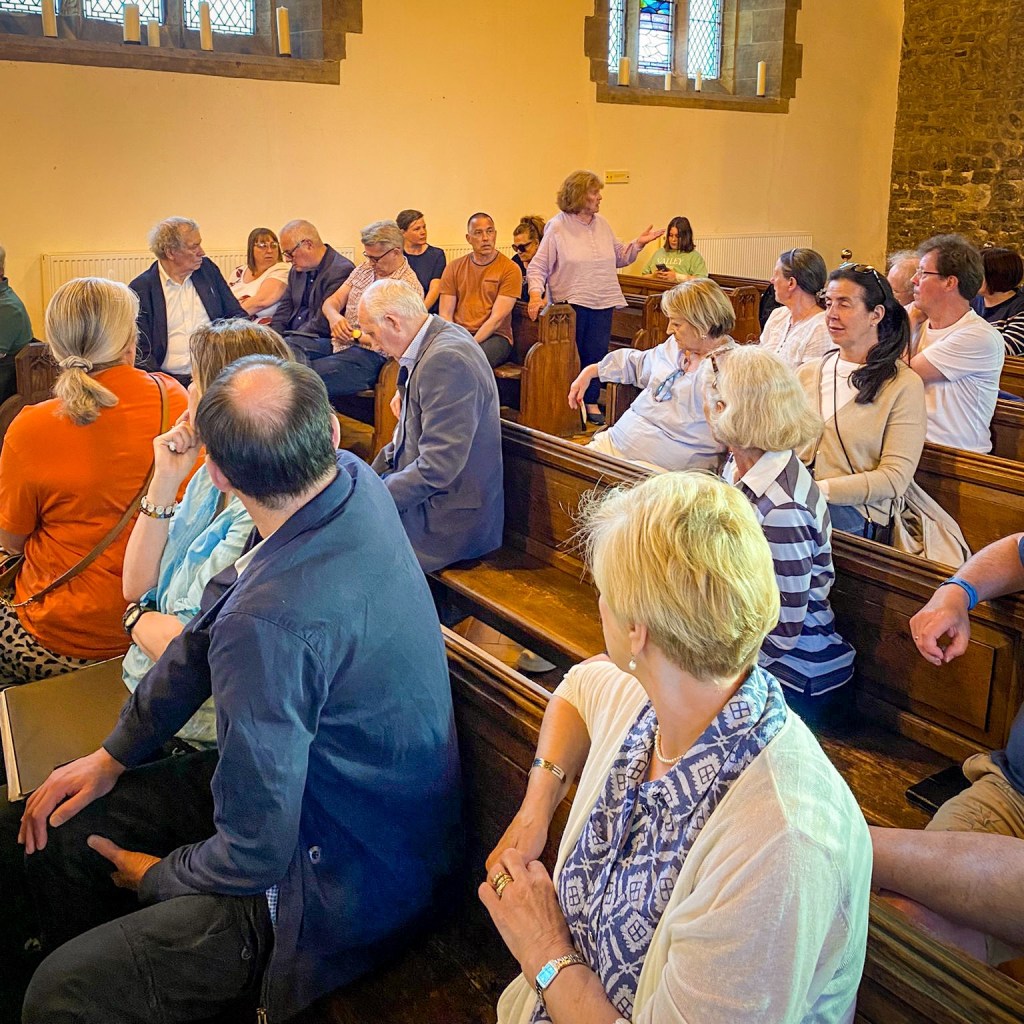
A lot of members of the audience wanted to share their own impassioned experiences of why the National Glass Centre was so important to them. There were previous employees, current staff, friends of the glass centre, students, family of students, cultural workers, politicians, councillors, glass blowers, artists, construction professionals, legal professionals, heritage professionals, campaign professionals, and even an ex mayor!
And, so many more fantastically useful people, all willing to help in any way they can!
What did people say at save the National Glass Centre public meeting?
The below list is as much as I can recall from the meeting. The meeting overran by nearly an hour, and there were many people who wanted to speak. Each and every viewpoint was clearly heartfelt, and many came with their own suggestions of how we could save the building and the skill set housed inside.
The building is unique, and impressive.
Glass blowing is an endangered craft.
Sunderland has a prestigious and long heritage of glass making. How can we ignore 1350 years of continuous skill in this City?
They do not want to lose an important part of their cultural identity.
They are extremely proud of the National glass centre.
The building has hosted internationally famous artists during programs like the Glass Exchange. It has a global draw, of which no other venue can boast.
It is wasteful to destroy such a young building.
There are still a lot of questions surrounding the maintenance of the building. Many noting that regular painting would have avoided catastrophic rust.
A commitment has been made by several attendees to further work on the save the National Glass Centre campaign.
Could Sunderland Culture, as an Arts Council NPO seek to take over custodianship?
Funds could be raised via crowdfunding, diversifying income streams, adopt a furnace, and/or levelling up fund (apparently Sunderland has only accessed 12% of it’s levelling up allocations).
There are concerns that the intent is to demolish one of our best assets.
If the building is donated back to the people via a suitable local organisation, all it embodies can be saved for future generations.
If properly invested in, the National Glass Centre could create an ambitious cross industry program to research the most efficient and sustainable way of making glass.
Demolition would have a high carbon cost. Can this be justified?
Other glass blowing courses and studios have closed. The National Glass Centre could have far more students, and potential hirers of equipment because of this.
It is worrisome that the dilution, and vast reduction of the current provision isn’t being questioned by more MPs and councillors.
There will be a huge loss of opportunity.
The city will lose highly skilled workers.
The loss of the National Glass Centre will effect our ability to level up.
Students are worried about being able to complete their studies.
Morale is currently low in the centre.
Questions surround Sunderland University’s proposed financial numbers in the online report. We are seeking more information.
How will our young access their cultural heritage with glass?
Worried about losing studio spaces, equipment, staff, specialists, and skills.
Inside St Peter’s church in Roker, by Phil Vickery
What happens next?
Time to organise our campaign and divvy out jobs!
Those who emailed, I will contact and organise a follow up so that we can form a crack team! With this team of knowledgeable people we will have the most effective campaign possible.
There’s still time to email if you want to form part of the steering group. Email:
Savethengc@gmail.com
Initially we will start with a monthly meeting on the 3rd Thursday of the month. Venue TBC.
Thank you for your support. Spread the word. Email, write to, or phone your MP. Write to the culture minister. Write to Sunderland University. Tell everyone to visit the National Glass Centre to show their support. The staff need to know we value them. Without the skilled people the National Glass Centre is just a groovy ship shaped box. But with them, the National Glass Centre is something important to be cherished.
I make ceramics, I’m not awell-knownartist, I don’t sell anything, I don’t make money from it and my careerwasin computing as an I.T. Manager.
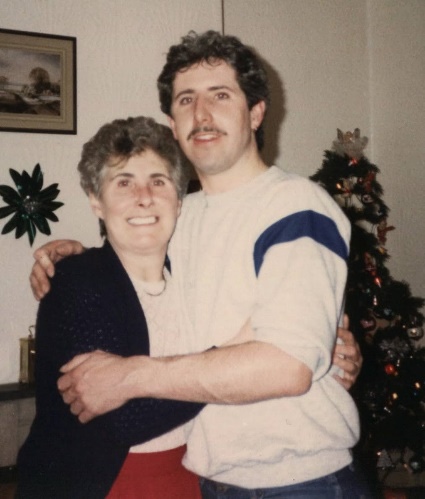
Sadly,my ceramics journey started with someone’s death. It wasn’t just anyone’sdeathbut mymother’smy “Mam” as we call them in the North.
In 2001 my Mam suddenly passed away. The shock and loss of a parent is always hard to cope with and I wasn’t doing it very well at allandIwas at a loss at how to stop feeling so sad allofthe time.
My life at that time was basicallygo toworkandsolvecomputerproblems,then come home and just think about missing my Mam. There seemed to be no way out of the sadness I felt. This couldn’t go onandafter a few weeks of this misery I decided something had to be done and I needed to break the cycle.
I thought perhaps an evening class would give me something to occupy my mind. I sawa Ceramics class advertised.Not only had I never done pottery before,but even better the course was free.I went along withsometrepidation, thinking“what have I signed up for?”After all,Iconsidered myselfto be a “techie”rather thanan“artist”.
In the class I was seated with 4 fantastic ladies who were around the same age as my Mam and they laughed and jokedthe whole time. They reminded me so much of my Mam, but in amuchhappier time.
They brought laughter back into my lifeand the sudden realisation that I enjoyed ceramics helped me to cope with grieving for her,byremembering the good times rather than her death. Suddenly life seemed awholelot better.
More importantly,every time I startedmakinga ceramic piece it always remindedme of my Mam.21 years later it still doesand Ihave a hugesmile thinking of her.
After a while I signed up for even more eveningcoursesbut this time at the National Glass Centre. Wow I was so overawed at their facilities and couldn’t believe I was making things there, me a mere hobby potter.
How proud I was that I was not only going to a centre of excellence but even more than that myDadhad been a “Plater” at the very shipyard which was situated on the site of the National Glass Centre. Even he was proud of me, a tough no-nonsense northern shipyard worker was impressed with his son’s creations,
what a surprise in my life.
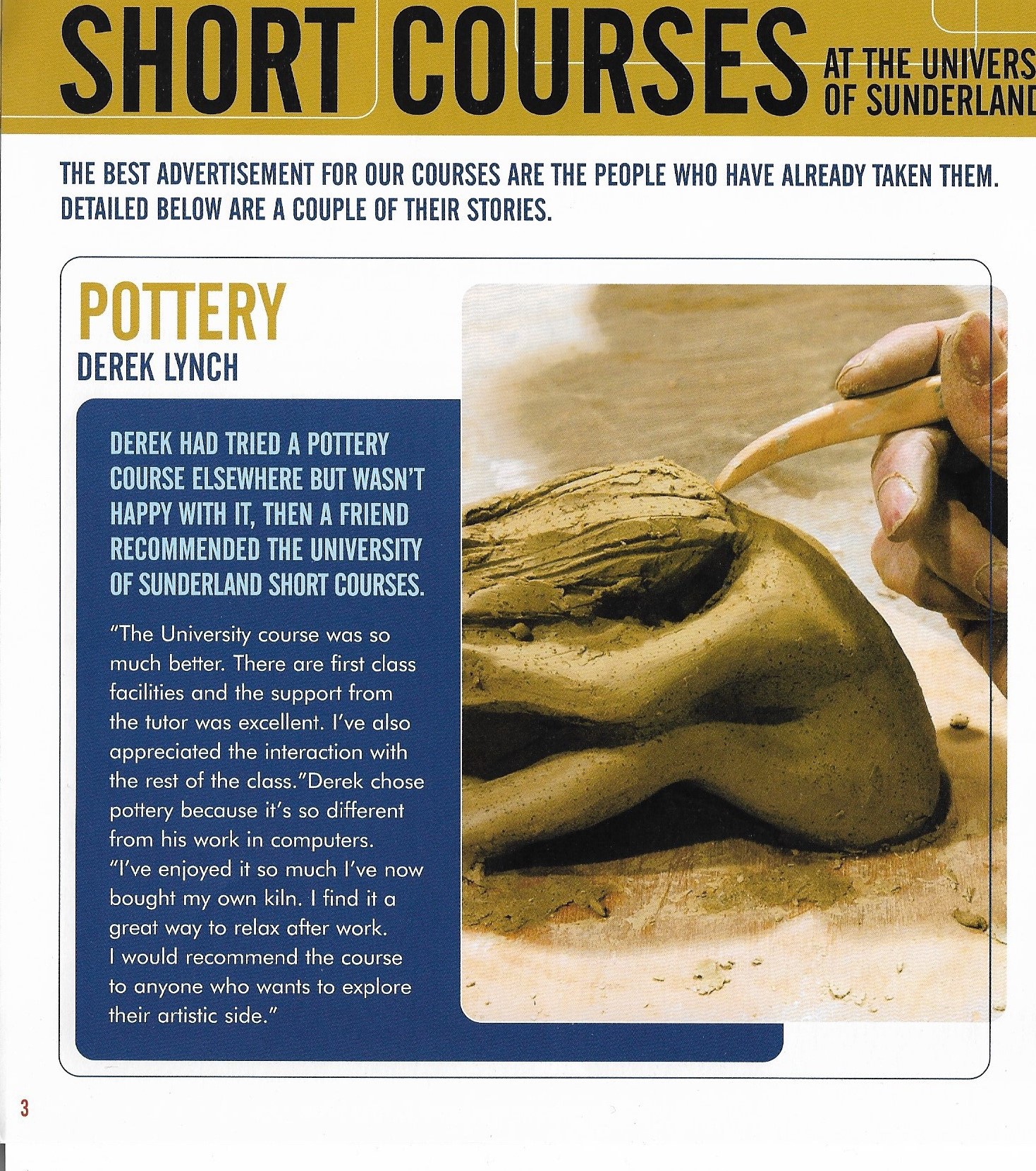
I evenmanaged toappearin the University’s learning booklet.
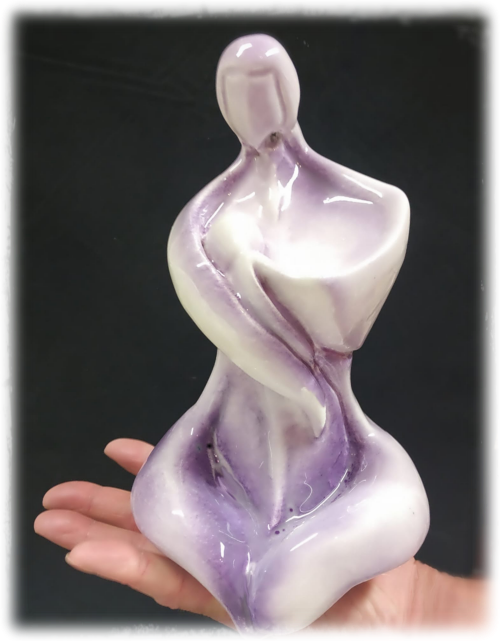
The professionalism ofthestaffteaching me,thechance to meet other students at the Glass Centre and being able to see what I could achieve eventually led me to purchase my ownkiln.ContactsImade on the coursesalso led to the purchase of myfirstpottery wheel.
Every time I either make a ceramic piece or look at the many pieces either in my house or the homes of people whohave myart,I think of my Mam. Not with sadness but with ahugesmile andI saythankyou toher.
So,this story isn’t really about me it’s about my Mam, who sadly never got to see any of myceramics or my journey fromanevening classin alittleschool through to thecountry’samazingNational Glass Centre.
The National Glass Centre was key to changing large parts of my life, all linked with someone sadly passing away and enabling others to smile when they receive a piece of my amateurish pottery, who would have thought it!!
My career was in computing, did I like it, well yes but my soul is in ceramics, do I like it, just ask my Mam she knows.
This iswhy all of myceramics are dedicated to her.
#SaveTheNGC #SaveTheNGCA
Do you have a story about the National Glass Centre?





 Save the National Glass Centre